I regret choosing Liverpool — I should have signed for Manchester United instead.
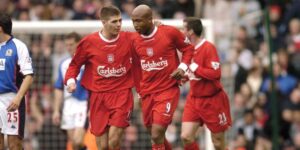
Choosing between Liverpool and Manchester United has never been straightforward.
Regardless of their positions in the league table, picking one over the other is like trying to choose between two equally loved children—an almost impossible call for any ambitious player without emotional ties to either side. Both clubs stand as giants of English football, decorated with history, trophies, and global prestige. Deciding which route to take is more like gambling on a race with no obvious winner: each has the pedigree, but the future is always uncertain. Even amid Manchester United’s struggles in recent years, the chance to wear the Red Devils shirt remains a dream for countless players.
El Hadji Diouf believed he had secured his dream move when Liverpool signed him following his standout performances at the 2002 World Cup. The Senegalese forward had dazzled on the global stage, inspiring his country to a stunning quarter-final run and delivering a man-of-the-match display against France that marked him as one of football’s rising stars. Impressed by his exploits, Liverpool manager Gérard Houllier paid £10 million to bring him from Lens to Anfield, with fellow Senegal international Salif Diao soon joining him.
What followed, however, was far from the fairy tale Diouf had imagined. By the end of his turbulent spell on Merseyside, his relationship with the club had deteriorated beyond repair. So bitter was the experience that Diouf later confessed he wished he had joined Liverpool’s arch-rivals Manchester United instead.
His Anfield debut offered brief optimism, as he scored twice and hinted at a bright future. But that promise quickly faded. Across 80 appearances, Diouf managed just six goals, leaving supporters frustrated and unconvinced during a spell overshadowed by controversy. Reflecting on his career years later, he admitted he would happily rewrite history and choose Manchester United—or even Barcelona—if given another chance.
In a 2018 interview, Diouf bluntly named Liverpool as the club he most regretted playing for, revealing that both United and Barcelona had been interested in him at the time. After his debut goals, his scoring dried up almost completely, and he endured a barren Premier League season the following year. His disciplinary issues only worsened matters, with a long list of bookings and a red card further alienating fans.
The lowest point of his Liverpool career came in 2003 during a UEFA Cup match against Celtic, when he spat at a supporter—an incident that led to a police investigation, suspension, and fine. By the time Houllier left the club in 2004, he openly admitted that signing Diouf had been one of his biggest mistakes, and the striker has since been widely labelled one of Liverpool’s worst transfers.
Had Diouf chosen Old Trafford instead of Anfield, he might have lifted the Premier League trophy under Sir Alex Ferguson. Instead, his poor form and off-field controversies forced him to reassess his career path. He later moved to Bolton Wanderers in an attempt to rebuild his reputation before spells at Blackburn Rovers and several other clubs followed.
Between 2002 and 2005, Diouf recorded 80 appearances for Liverpool, scoring six goals and providing 13 assists, while also collecting 19 yellow cards and two red cards.
Diouf’s strained relationship with Liverpool extended beyond the fans to his former teammates. Jamie Carragher publicly labelled him one of the worst players he had ever played with, criticising his work rate and attitude. Steven Gerrard echoed similar sentiments in his autobiography, accusing Diouf of selfishness and a lack of commitment to the club’s cause.
While Carragher and Gerrard went on to achieve legendary status with Liverpool, including winning the Champions League in 2005, Diouf’s career took a very different path. He moved through clubs such as Bolton, Sunderland, Blackburn, Rangers, Doncaster and Leeds before ending his playing days in Malaysia in 2016—his early promise never fully realised.