“I Wish I’d Chosen Manchester United Over Liverpool — It’s a Decision I Regret.”
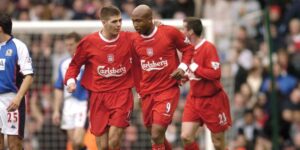
Choosing between Liverpool and Manchester United, no matter their positions in the league table, is often likened to picking a favourite child — an almost impossible task for a player without a deep personal connection to either club who simply wants to leave a lasting mark in the Premier League.
Both giants stand atop English football history, their trophy cabinets overflowing and their legacies etched in gold and silver. Yet deciding which route to take is anything but straightforward. It’s like backing a two-horse race with no obvious winner: both have pedigree, but the future remains uncertain. Although Manchester United have endured turbulent spells in recent years, the allure of wearing the Red Devils’ badge still represents a lifelong ambition for countless players.
El Hadji Diouf believed he had landed his dream move in the opposite direction when Liverpool signed him following his standout performances at the 2002 World Cup. Instead, the transfer quickly turned sour. The Senegalese forward burst onto the global stage after inspiring his country to a remarkable quarter-final run, producing a man-of-the-match display against France that caught the attention of Europe’s elite. Convinced, Liverpool manager Gérard Houllier paid £10 million to bring Diouf to Anfield from Lens, later adding his international teammate Salif Diao to the squad.
By the end of Diouf’s chaotic spell on Merseyside, the relationship between player and club had completely collapsed. The experience left such bitterness that Diouf later admitted he wished he had joined Liverpool’s fierce rivals, just 30 miles away, instead.
El Hadji Diouf admits he regrets joining Liverpool
Given his struggles, many Reds supporters felt the same
A brace on his Anfield debut briefly raised expectations, but it proved misleading. Diouf scored only six goals in 80 appearances, delivering more controversy than celebration during his time at the club. Reflecting on his career years later, the forward confessed he would gladly rewrite history and choose Manchester United over Liverpool.
In a 2018 interview with RMC Sport, Diouf was asked which club he most regretted playing for. His answer was direct:
“I would say Liverpool,” he said, as quoted by the Mirror.
“Because if I had the chance again, I would go to Manchester United or Barcelona. They wanted me at the time too.”
After scoring on his debut, the now 44-year-old failed to find the net again in the league until March and then went an entire Premier League season without scoring. His disciplinary issues only made matters worse — accumulating 13 yellow cards and a red in his final campaign — and his relationship with supporters deteriorated rapidly.
The lowest point came during a UEFA Cup tie against Celtic in March 2003, when Diouf spat at a fan. The incident resulted in a police interview, a two-match ban and a fine equivalent to two weeks’ wages. When Houllier departed in 2004, he later admitted that spending £10 million on Diouf ranked among his biggest managerial regrets. Today, the striker is widely regarded as one of Liverpool’s worst-ever signings.
Had Diouf opted for Old Trafford instead of Anfield, he would have collected a Premier League winner’s medal under Sir Alex Ferguson. Instead, his poor goal return and repeated misconduct forced him to reassess his career. He moved on to Bolton Wanderers, spending four years attempting to restore his reputation, before reuniting with Sam Allardyce at Blackburn Rovers.
El Hadji Diouf at Liverpool
Years: 2002–2005
Appearances: 80
Goals: 6
Assists: 13
Yellow cards: 19
Red cards: 2
Why Diouf is seen as Liverpool’s most disliked former player
Even club legends couldn’t hide their frustration
While Diouf’s resentment towards Liverpool was clear, it was overshadowed by the animosity his former teammates felt towards him. Jamie Carragher, who experienced both highs and lows at the club, did not hesitate to label Diouf the worst teammate he played alongside.
After retirement, Diouf and Carragher continued their feud publicly, exchanging barbs in interviews and on social media. Carragher once said:
“He has one of the worst strike rates of any forward in Liverpool’s history. He’s the only number nine to go a whole season without scoring. He was always the last one picked in training.”
He added bluntly:
“The worst has to be El Hadji Diouf. I actually enjoyed playing against him — at least then you could kick him. You can’t kick your own players.”
Steven Gerrard echoed similar sentiments in his 2007 autobiography, writing:
“I wasn’t Diouf’s biggest fan. Around Melwood and Anfield, you could tell who was hungry and who really cared about Liverpool. Diouf was only interested in himself. His attitude was wrong, and I didn’t feel he was prepared to put his body on the line to get the club back to the top.”
Ultimately, Diouf’s unwavering self-belief failed to translate into success. While Carragher and Gerrard went on to lift the Champions League in 2005, Diouf’s career took him through Bolton, Sunderland, Blackburn, Rangers, Doncaster and Leeds United. He eventually retired in 2016 after a short spell playing in Malaysia.